
Article
Is Disney's Polynesian Village Resort Worth It in 2026? Honest Review & Price Guide
Is Disney's Polynesian Village Resort worth $600–$1,200/night in 2026? Honest review covering rooms, dining, transportation, pools, and who should book it.
On this page
- What Is Disney’s Polynesian Village Resort?
- How Much Does It Cost to Stay at the Polynesian in 2026?
- What Are the Rooms and Theming Really Like?
- What Dining Options Are at the Polynesian?
- How Does Transportation Work from the Polynesian?
- What Are the Pool Areas Like?
- Who Should (and Shouldn’t) Stay at the Polynesian?
- Is the Polynesian Village Resort Worth It in 2026?
- Frequently Asked Questions
- Planning Your Visit: What This Means for Your Trip
Disney’s Polynesian Village Resort is a Magic Kingdom monorail resort on Seven Seas Lagoon offering ~847 rooms across 11 Hawaiian-named longhouses. Standard rooms run $610–$740/night in 2026, with lagoon and theme park views reaching $900–$1,200/night. For guests who prioritize location, theming, and dining convenience, it delivers. For guests who prioritize room size or value, the math gets harder.
The gap between Disney’s moderate and deluxe resort tiers has widened sharply heading into summer 2026. Port Orleans Riverside — a solid moderate — runs $250–$350/night, making the Polynesian’s entry price point roughly double or triple depending on the season. That gap demands a clear-eyed answer about what you actually get for the difference, and this review gives you one.
What Is Disney’s Polynesian Village Resort?
The Polynesian is one of Walt Disney World’s original resort hotels, opening on October 1, 1971 — the same day as Magic Kingdom. It sits on Seven Seas Lagoon with direct monorail access to the park, placing it in an elite tier of three resorts on the Magic Kingdom monorail loop alongside the Grand Floridian and the Contemporary.
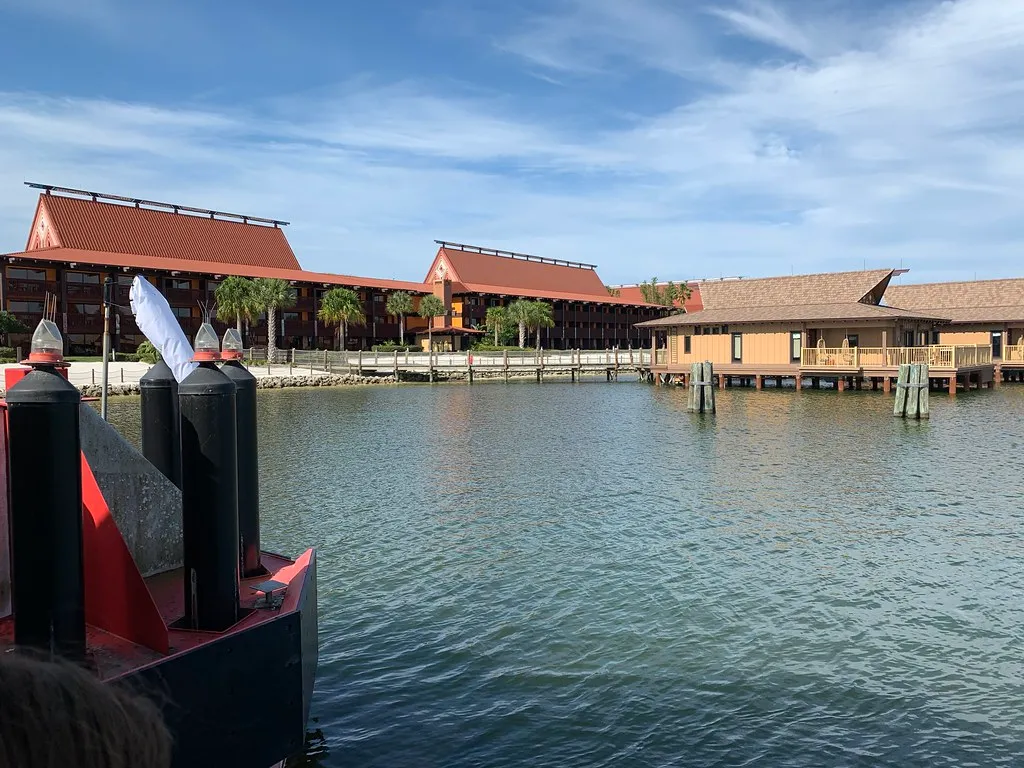
The resort spans 11 guest longhouse buildings, each named after a Pacific Island or region — Tokelau, Pago Pago, Moorea, Samoa, and others. The main hub is the Great Ceremonial House, a soaring two-story atrium filled with tropical plants, tiki carvings, and the kind of immersive theming that Disney does better than anyone. Walking through those doors, the sensory shift is immediate.
With roughly 847 rooms spread across the longhouses plus 20 over-water DVC bungalows perched above the lagoon, the resort is substantial without feeling like a convention hotel. Longhouse buildings are two or three stories, connected by winding paths through lush tropical landscaping that genuinely earns the South Pacific premise.
Disney has invested in the property consistently since its 1971 opening. The theming coherence — from the tapa cloth prints on the bedspreads to the fire torches lit each evening along the lagoon — is a meaningful part of what you’re paying for, and it holds up across multiple stays in a way that more generic properties do not.
How Much Does It Cost to Stay at the Polynesian in 2026?
Standard rooms at the Polynesian start at approximately $610/night in 2026 and reach $1,200/night for theme park view rooms during peak periods. Club Level adds another layer above that, and the over-water bungalows represent a category of their own at $2,200–$3,500+/night. All prices are subject to change and vary significantly by season.
| Room Category | 2026 Nightly Rate | Key Details |
|---|---|---|
| Standard / Garden View | $610–$740 | Faces parking lot or landscaping; no lagoon |
| Lagoon View | $750–$900 | Seven Seas Lagoon; partial Magic Kingdom sightlines |
| Theme Park View | $950–$1,200 | Direct Magic Kingdom view; fireworks from your balcony |
| Club Level (Kamehameha Lanai) | $1,100–$1,500 | Lounge access with food/beverage service throughout day |
| Over-Water Bungalows (DVC) | $2,200–$3,500+ | 20 bungalows; DVC member priority; overwater deck |
A few cost considerations that aren’t obvious from the rate card. Disney resort pricing varies dramatically by season — a room that costs $650 in early September can hit $1,100+ during spring break or holiday weeks. Club Level lounge access can offset $80–$120 per adult per day in dining costs through its food and beverage service, which includes breakfast items, afternoon snacks, and evening appetizers. For families who use the lounge consistently, Club Level pricing can approach break-even compared to paying out of pocket for equivalent meals.
Parking runs $25–$35/night for self-parking at Disney deluxe resorts. Guests arriving by Disney transportation avoid that cost entirely, which matters for families driving in from outside Orlando and spending five or more nights on property.
What Are the Rooms and Theming Really Like?
Polynesian rooms run approximately 410 square feet for standard configurations — adequate for two adults, tight for a family of four with luggage spread out. The theming is genuinely excellent: warm tones, tapa-inspired textiles, tropical hardwood finishes, and Moana accents in the newer longhouses. The quality is real, but 410 square feet is 410 square feet regardless of how nicely it’s decorated.
Rooms were refreshed with a Moana-inspired theme in recent years, and the update landed well. Soft goods feature ocean blues and warm sandy tones, artwork references the Pacific theming without feeling like a licensed character explosion, and the overall palette feels cohesive. Compared to dated rooms at some Disney deluxe properties, the Polynesian’s interiors feel current.
Standard rooms fit two queen beds or one king, a small table with two chairs, a dresser, and a modest bathroom. Disney added a split bathroom design to many Polynesian rooms — a separate sink and vanity area outside the toilet and shower — which is genuinely useful for families getting ready in the morning. The layout earns its keep.
View categories matter more here than at almost any other Disney resort. The naming can be misleading: standard or “garden view” rooms do not face the lagoon. They face the parking area or interior landscaping. Guests who book without reading the fine print sometimes feel let down when they open the balcony door to see a parking structure. Lagoon view rooms start around $750/night and deliver a genuine water view with partial sightlines toward Magic Kingdom. Theme park view rooms, at $950–$1,200/night, put Cinderella Castle directly in your sightline from the balcony — and during evening fireworks, that view is legitimately extraordinary.
Balconies or patios are standard on most room types. Having outdoor space where kids can decompress after a long park day has real value, and the tropical landscaping makes those spaces feel like part of the resort experience rather than an afterthought.
What Dining Options Are at the Polynesian?
Five distinct dining venues cover everything from quick coffee and a Dole Whip to a character breakfast and a beloved family-style dinner. ‘Ohana is the flagship and requires advance planning starting 60 days before your trip. Taken together — particularly with Trader Sam’s Grog Grotto for adults — this is one of the stronger on-property dining ecosystems among Magic Kingdom area resorts.
‘Ohana is the resort’s centerpiece restaurant. Dinner is family-style at approximately $62–$67 per adult and features skewered meats, noodles, vegetables, and bread pudding served continuously at your table. The atmosphere is warm and loud in the best way — communal energy, ukulele music, and hula dancing create an experience that’s genuinely fun rather than just a meal. Character breakfast runs approximately $42–$47 per adult with Lilo, Stitch, Mickey, and Pluto. Both meals require advance dining reservations, and ‘Ohana ADRs open at the 60-day mark at 6am ET — set an alarm, log in before 6am, and move quickly. They book out in minutes.
Kona Cafe serves table-service breakfast, lunch, and dinner for guests who want a sit-down meal without the ‘Ohana price point or the reservation scramble. Entrees run approximately $18–$38 at dinner, and the breakfast menu — including Tonga Toast, a strawberry-stuffed deep-fried sourdough — has a devoted following. Kona is reliably good and significantly easier to book, making it a strong fallback option.
Captain Cook’s handles quick-service needs with bowls, sandwiches, and entrees ranging from approximately $12–$22. It’s open 24 hours, which matters more than it sounds — after a late evening at Magic Kingdom, having a decent quick-service option on property beats driving or taking a bus to find food. Tonga Toast is also available here for breakfast.
Trader Sam’s Grog Grotto deserves its own paragraph because it’s genuinely one of the best bars at all of Walt Disney World. An intimate tiki bar with theatrical cocktails, animatronic surprises triggered by certain drink orders, and an atmosphere that rewards lingering — no advance dining reservation is required, but it opens around 4pm daily and fills fast. Arriving at or just before opening minimizes the wait significantly. The adjacent outdoor Tiki Terrace handles overflow and is a pleasant option in its own right.
Finally, Pineapple Lanai serves Dole Whip — floats, soft-serve variations, and a few snack items — from an outdoor counter near the Great Ceremonial House. It’s a small detail that adds disproportionate happiness to a resort stay.
How Does Transportation Work from the Polynesian?
Transportation to Magic Kingdom from the Polynesian is the best of any Walt Disney World resort. The monorail runs approximately 5 minutes door-to-park, a Friendship boat crossing takes 7–10 minutes, and a lakeside walking path adds a scenic 15-minute option. EPCOT requires a monorail transfer and takes around 20 minutes total. Hollywood Studios and Animal Kingdom require a bus, typically 25–35 minutes.
The Magic Kingdom Resort Monorail is the defining transportation advantage of staying here. The loop stops at the Polynesian, Grand Floridian, and Contemporary before reaching Magic Kingdom, making park arrivals and departures seamless. On busy days when bus queues at other resorts stretch long, Polynesian guests step onto a monorail and arrive steps from the park entrance. That time savings compounds across a multi-day trip in a way that’s easy to underestimate at booking.
A Friendship boat crosses Seven Seas Lagoon to the Transportation and Ticket Center in approximately 7–10 minutes. Many guests prefer the boat on return trips after evening shows, when the monorail platform crowds with departing guests. The lakeside walking path connecting the Polynesian to the TTC and Magic Kingdom entrance takes about 15 minutes at a comfortable pace and is a genuinely pleasant option on cooler mornings or late-evening returns.
EPCOT access runs through the TTC on the Express Monorail, adding a transfer step and bringing the total journey to around 20 minutes. Hollywood Studios and Animal Kingdom both require a bus, averaging 25–35 minutes depending on traffic and stops. Guests with itineraries weighted toward those two parks will feel the difference compared to EPCOT-area or Hollywood Studios-area resorts.
One underappreciated option: the resort’s position on Seven Seas Lagoon means guests can watch Magic Kingdom fireworks from the resort beach without entering the park. The view is excellent, it’s free, and avoiding the post-show park crowd exodus saves meaningful time on evenings when you want to end the night earlier.
What Are the Pool Areas Like?
The Polynesian’s primary pool is the Nanea Volcano Pool, featuring a 142-foot water slide, zero-entry wading area, and a poolside bar. It’s a strong pool — well-themed, well-sized for the resort’s capacity, and suitable for all ages. Compared to the best pools in Disney’s deluxe category, it ranks solidly in the middle of the pack rather than at the top.
Nanea Volcano Pool’s volcanic rock theming is well-executed, the slide delivers enough speed to satisfy older kids without intimidating younger ones, and the zero-entry section makes the pool accessible for families with toddlers. The Oasis Bar and Grill handles poolside food and drinks without requiring guests to leave the area — a quality-of-life feature that earns its keep on full pool days.
Pool hours run typically 7am to midnight, which is unusually generous. Early morning swims before park opening and late-night swims after fireworks are both viable, and that flexibility matters for families trying to maximize their days without feeling rushed.
Honest comparison: the Polynesian’s pool is genuinely good, but the Yacht and Beach Club’s Stormalong Bay — a three-acre water park with a sandy-bottom section, lazy river, and shipwreck slide — sits in a different category entirely. Wilderness Lodge’s pool also earns strong marks. Families for whom the pool is the top resort amenity priority may find those properties more compelling. The Polynesian’s pool is a strong supporting feature; it is not the reason to choose this resort.
A secondary quiet pool near the Tokelau building provides an alternative for guests who want a calmer experience away from the main pool energy — no water slide, no crowd, just a pool and lounge chairs in a well-landscaped setting.
Who Should (and Shouldn’t) Stay at the Polynesian?
Disney’s Polynesian Village Resort delivers maximum value for Magic Kingdom-focused families who value theming, dining variety, and transportation convenience above room size and pure value. Guests who spend most of their time at EPCOT, Hollywood Studios, or Animal Kingdom — or who need more than 410 square feet — will find better fits elsewhere in the deluxe tier.
| The Polynesian is right for you if… | Consider another resort if… |
|---|---|
| Magic Kingdom is your primary or only park | EPCOT, Hollywood Studios, or Animal Kingdom anchor your trip |
| Theming and atmosphere are meaningful priorities | You need more than 410 sq ft (consider a suite or villa) |
| You want 'Ohana, Kona Cafe, or Trader Sam's on property | You plan to eat primarily at parks or off-property |
| You want monorail access for young children | A world-class pool complex is your top amenity priority |
| Fireworks visible from the resort beach matter to you | Budget is the primary constraint |
| Adults in your group will use Trader Sam's | You're considering the over-water bungalows for value |
A specific note on the bungalows: at $2,200–$3,500+ per night, they represent poor value for most families by any financial measure. The overwater deck is genuinely beautiful, but the space and amenities do not justify the rate premium over a theme park view room for guests spending their days in the parks. DVC members using points may find the calculus different. Cash guests booking bungalows purely for the experience should go in with clear eyes about the trade-off.
Is the Polynesian Village Resort Worth It in 2026?
The Polynesian is worth its price for Magic Kingdom-focused trips where transportation, theming, and dining are valued. At $610–$740/night for standard rooms, it’s a hard sell for guests who won’t use the monorail heavily or book ‘Ohana. At lagoon and theme park view price points, the experience justifies the cost for the right traveler — particularly for milestone trips and families with young children.
| Pros | Cons |
|---|---|
| Best Magic Kingdom transportation of any resort | Standard rooms face parking lot, not the lagoon |
| Exceptional immersive theming throughout property | 410 sq ft is modest at this price point |
| Five strong dining venues including 'Ohana and Trader Sam's | 'Ohana ADRs require aggressive early-morning planning |
| Fireworks viewing from the resort beach at no charge | Pool is solid but not best-in-class for Disney deluxe |
| Monorail, boat, and walking path all serve Magic Kingdom | Hollywood Studios and Animal Kingdom require a bus |
| Club Level lounge can offset significant daily dining costs | Over-water bungalows are poor value for most cash guests |
| Pineapple Lanai Dole Whip on property | Price gap vs. moderate resorts is $350–$600/night |
For a family spending three or four days primarily at Magic Kingdom, the monorail convenience alone removes meaningful friction from the trip. Combined with ‘Ohana dinner, Trader Sam’s in the evening, and fireworks from the beach, the Polynesian creates a resort experience that becomes part of the vacation rather than just a place to sleep. That is worth real money to a lot of families.
For a family splitting time evenly across all four parks, a lagoon or theme park view room at $800–$1,200/night becomes harder to justify. The transportation advantage evaporates for non-Magic Kingdom days. In that scenario, the BoardWalk Inn for EPCOT access or Wilderness Lodge for a similarly strong theming experience at a somewhat lower entry point deserve serious comparison.
Specific room type matters enormously. Booking a standard view room to save $100–$150/night is reasonable — but know what you’re getting. If waking up to a lagoon view or watching fireworks from your balcony is part of what you’re paying for, budget for lagoon or theme park view categories accordingly. The difference between a standard view and a theme park view room is not a minor upgrade; it’s a fundamentally different experience of the same resort.
Common mistakes that lead guests to regret the booking: choosing the standard view room without understanding what the view actually looks like, failing to secure ‘Ohana reservations at the 60-day window, not knowing about Trader Sam’s and therefore missing the resort’s most distinctive adult experience, and booking the Polynesian for a trip that centers on Hollywood Studios or Animal Kingdom. Avoid those four mistakes and the Polynesian will almost certainly exceed expectations.
Frequently Asked Questions
How far is Disney’s Polynesian Village Resort from Magic Kingdom?
The Polynesian sits directly across Seven Seas Lagoon from Magic Kingdom. The resort monorail takes approximately 5 minutes, the Friendship boat runs 7–10 minutes, and the lakeside walking path is about 15 minutes on foot. No other Walt Disney World resort offers comparable access to Magic Kingdom across all three transport options simultaneously.
How do I get an ‘Ohana reservation at the Polynesian?
‘Ohana reservations open at the 60-day mark before your dining date at 6am Eastern Time on the My Disney Experience app or Disney’s dining reservation system. Both breakfast and dinner book out within minutes — often under 10 — on peak dates. Log in before 6am, have your party size and date ready, and move immediately. Same-day cancellations occasionally open slots, so checking app day-of is also worth a few minutes.
Are the over-water bungalows at the Polynesian worth it?
For most families paying cash rates of $2,200–$3,500+ per night, the over-water bungalows are not strong value. The lagoon deck and location are genuinely beautiful, but the amenity premium over a theme park view room does not justify the cost for guests spending their days in the parks. DVC members using points may find the value calculation different depending on individual point costs.
What does a standard room view look like at the Polynesian?
Standard and “garden view” rooms face the parking area or interior resort landscaping — not Seven Seas Lagoon. Many guests are surprised to find no water view from the balcony. Lagoon view rooms start around $750/night in 2026 and deliver a genuine water view. If a lagoon view matters to your experience, confirm the room category explicitly at booking.
Is the Polynesian Village Resort good for adults without children?
Trader Sam’s Grog Grotto alone makes the Polynesian one of the stronger adult-oriented resorts at Walt Disney World — a theatrical tiki bar with inventive cocktails that rewards lingering. Kona Cafe offers solid table-service dining without a character component. The lagoon beach with fire torches and fireworks views is genuinely atmospheric, and the overall vibe skews warm and festive rather than strictly family-focused.
How does Disney’s Polynesian Village Resort compare to the Grand Floridian?
Both share the Magic Kingdom monorail loop but offer distinct atmospheres. The Grand Floridian skews more formal and Victorian, with a higher price ceiling and Victoria & Albert’s as its flagship fine-dining anchor. The Polynesian is warmer, more casual, and typically $100–$200/night less expensive for comparable room categories. Families with young children tend to prefer the Polynesian; adults seeking Disney’s most formal luxury experience generally lean toward the Grand Floridian.
Planning Your Visit: What This Means for Your Trip
If the Polynesian fits your itinerary, a few planning priorities will meaningfully improve your stay. Book your ‘Ohana ADR the moment the 60-day window opens — set an alarm for 5:55am ET, be logged into the My Disney Experience app before 6am, and have your party size and date ready to confirm immediately. Treat Trader Sam’s Grog Grotto as an evening anchor rather than an afterthought, and arrive at or just before the 4pm opening to avoid a long wait. For room selection, weigh the standard view honestly: saving $100–$150/night is real money on a multi-night stay, but a lagoon or theme park view room is a materially different experience — particularly for families who want fireworks visible from the balcony. If you’re considering Club Level, estimate your family’s daily food and beverage spend and compare it to the lounge offset of $80–$120 per adult per day; for families who eat breakfast and evening snacks at the lounge consistently, the upgrade often approaches break-even. Watch Magic Kingdom fireworks from the resort beach on at least one evening — it requires no park ticket, the view is excellent, and it’s one of those experiences unique to staying at a Seven Seas Lagoon property. Finally, build in at least one slower morning at the Nanea Volcano Pool. Rope-dropping every park day is exhausting; a mid-trip pool morning restores energy and lets the resort itself become part of the vacation.
Planning a Disney World vacation? Main Street Magic offers completely free vacation planning services — our expert planners handle every detail from tickets to dining reservations at no cost to you. Start planning your magical trip today.
Filed under
Planning a trip like this? Skip the research — talk to a Main Street Magic advisor (it's free).
Start Planning →More from hotel-resort-reviews
Is Disney's Riviera Resort Worth It in 2026? Honest Review & Price Guide
Honest 2026 review of Disney's Riviera Resort: room quality, pricing ($500-$1,000/night), dining, Skyliner access, and pools. Find out if it's worth booking.
Is Disney's Old Key West Resort Worth It in 2026? Honest Review & Price Guide
Is Disney's Old Key West Resort worth $400-$800/night in 2026? Honest review of room sizes, dining, pools, and transportation — plus free planning help.
Is Disney's Yacht Club Resort Worth It in 2026? Honest Review & Price Guide
Disney's Yacht Club Resort review for 2026: real prices, room quality, Stormalong Bay, dining, and transportation — plus an honest worth-it verdict for your trip.